


It’s the ideal offering for a field in transition.
Life science and biotech companies have weathered storms in the past few years, and the slowdown in the industry has changed the way organizations solve their lab and office space requirements, often looking at short-term, move-in ready options rather than long build-outs and commitments. On another front, innovation in robotics and AI is driving a reevaluation of space requirements and work processes across lab operations, according to industry reports.
These changes are behind a striking jump in the leasing of turnkey lab spaces that enable firms to move in and start work immediately, rather than waiting for custom interior construction.
How do owners/developers create ideal turnkey space that isn’t too much or too little? What are some of the tips and traps for successful design of these speculative improvements, aka spec suites?
Over the past two years, King Street Properties has expanded options for life science firms by building spec suites that complement the larger full-floor offerings at several of our properties.
Anti-aging innovator Generation Lab recently moved into a spec suite at The Landing, King Street Properties’ new purpose-built life science project in the San Francisco Peninsula, and last month a robotics-and-AI-enhanced materials maker for life sciences, Interfacial Consultants, took occupancy in turnkey space at our Mesa Labworks property in San Diego. Both firms expressed speed-to-market as a key attraction, along with the amenities and location of these life science assets.
Research from real estate services firm JLL indicates spec suites are in high demand because they speed up a tenant’s move-in date, lower some of their upfront costs and provide flexibility in lease terms and expansion.
JLL also reported that venture capital investment in life sciences in the second half of 2025 was at its strongest since 2022, signaling more companies will need space in the coming quarters as they expand operations. Meanwhile, new construction has slowed significantly, helping market stabilization and allowing future absorption to result in a decline in availability.
Cushman Wakefield also reported strengthening funding for the sector. While still below its peak of 2020 to 2021, life science funding appears to have ended its decline and settled back into a more normalized long-term range, above $160 billion annually.
Across our experience accommodating life science firms with move-in ready lab space, we’ve found several strategies can offer keys to success.
Finding the lab-office sweet spot
Life science firms balance lab space to office space at different amounts, depending on the company’s size, science, operations and other aspects. Move-in ready suites make the most sense for midsize to smaller firms focused on speed-to-market. These start-ups and early-stage companies tend to seek roughly 10,000 square feet up to 20,000 or 25,000 square feet and typically want 50 to 60 percent of it as lab vs. office. Locating spec suites on floors where they can easily expand also provides sequential growth opportunities. At The Landing, we created three spec suites of stair-stepped sizes on a single floor, and Generation Lab was able to identify an ideal space, moving into the building in less than two months.
Keep it modular, even mobile
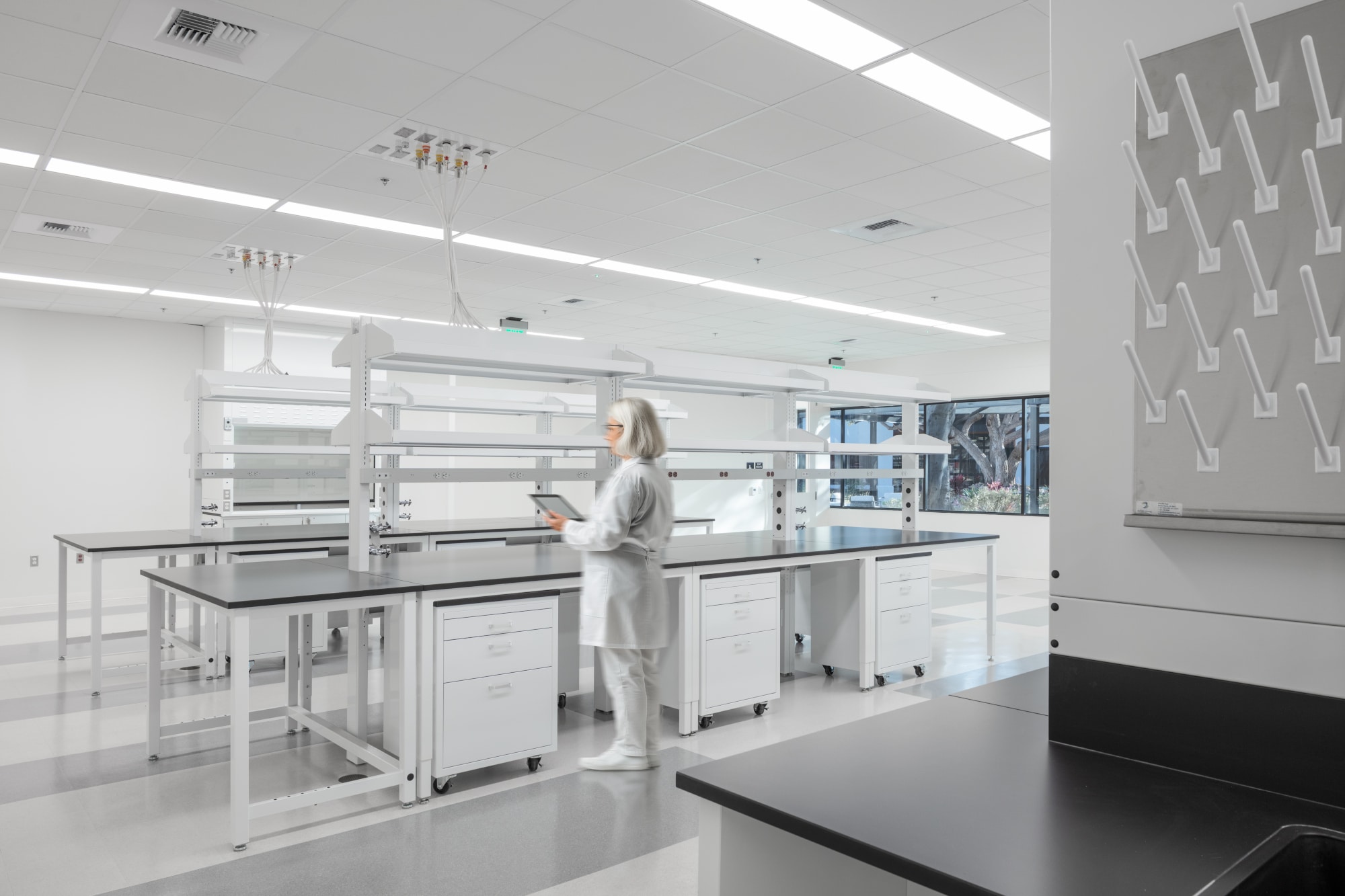
In our spec suites, we’re finding that wet labs, benches and infrastructure are ideally built out in modular components as much as possible to enable customization for tenants. For example, raceway utility connections at walls and columns facilitate moves or changes with ease. And with mechanical, electrical and plumbing systems located in ceilings, we’re able to be more flexible in tailoring to a tenant’s equipment needs. Mobile casework is also ideal for reconfiguring lab space for different users or even different needs within a single company’s lease term.
Accentuating purpose-built ‘extras’
The defining characteristics of purpose-built life science space are its extra features and infrastructure, compared to traditional office space. Innovation companies in biosciences often need specialization and future-planning baked into their workplace. Needs may include significantly more power supply, wider column-to-column widths and higher ceilings and structural design that can accommodate special equipment. As companies are now evaluating needs and impacts such as robotics, pilot manufacturing and AI, these over-standard features are a key attribute that life science property owners and developers can lean into to accommodate future-focused firms.
Of course, developers need to weigh carefully the upfront expense of turnkey space. Is the local market suited for this offering? What recent leasing trends indicate potential interest? Are the tenant improvements in broad demand or is there risk of obsolescence?
As the life science industry continues to rebound, owners and operators who offer purpose-built, flexible and amenitized spaces as well as spec space options are well positioned to attract tenants.