


From Hannah Baratham-Green, Triangle Business Journal
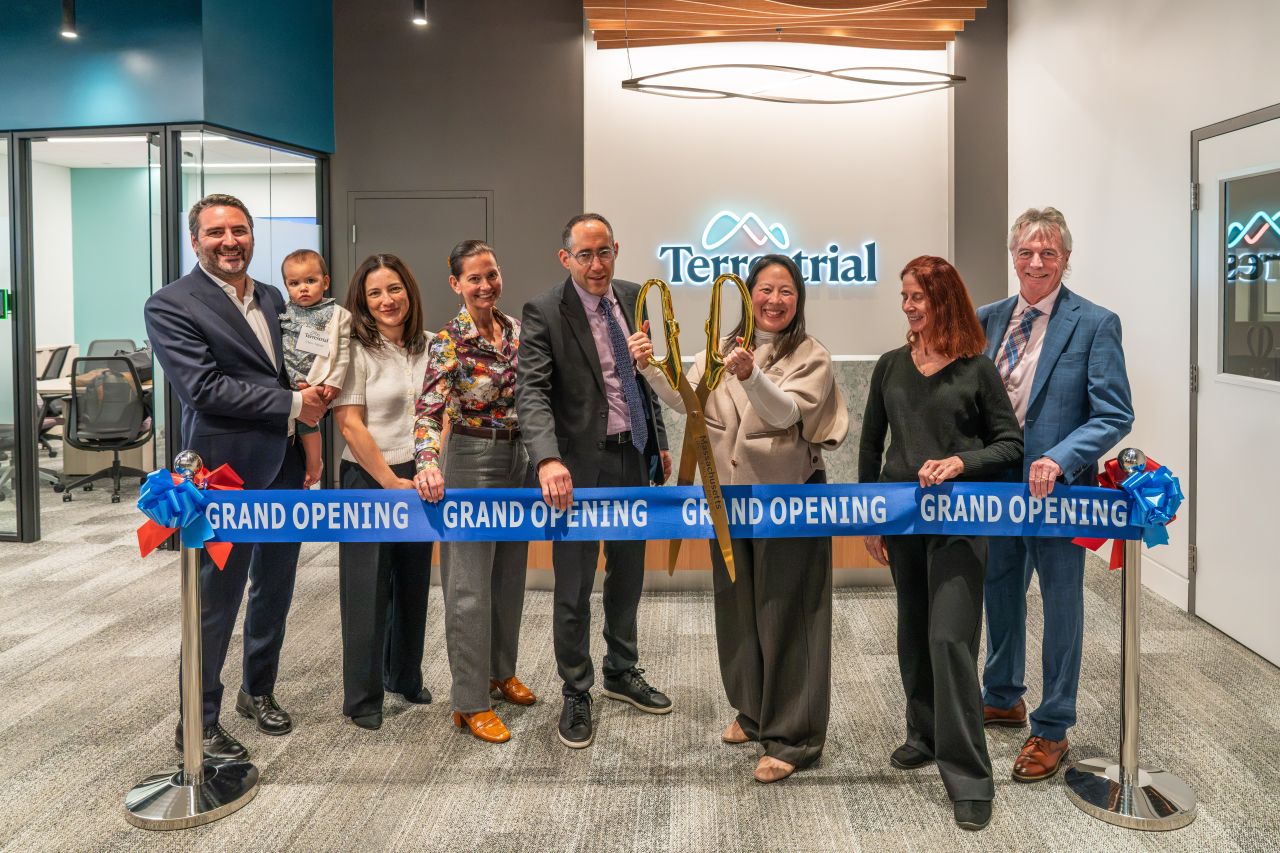
Terrestrial Bio has opened its new headquarters and manufacturing facility in Boston.
It was only March 2026 when Terrestrial signed a lease for 42,000 square feet at 250 Western Avenue at Allston Labworks. The company said it was relocating its headquarters from Woburn to Boston’s Allston neighborhood, where it would have lab, office and manufacturing space. Terrestrial plans to transition out of Woburn fully in 2028.
“If I told you all that we signed a lease for building the facility in March and delivered space in September, for those of you who know anything about construction timelines, that is pretty much a miracle that happened. But it took a lot of trust on both sides,” Michael DiMinico, partner and managing director at King Street, said at an October ribbon-cutting event.
Terrestrial was the first biotech tenant that King Street Properties secured for its massive Allston mixed-use development. Allston Labworks is a three-building development that has 35 residential apartments, retail space, and over 500,000 square feet of life science and office space. Also in Terrestrial’s building is BioBuilder, a nonprofit that offers life sciences educational programming.
At the same time it signed its Allston lease, the company announced a rebranding from Vaxess Technologies and a new $50 million Series C funding led by RA Capital.
These announcements came at an inflection point for Terrestrial. The company was founded around technology that uses skin patches to deliver vaccines and drugs without needles and without the need for refrigeration. While initially focused on delivering vaccines, the company is now focused on delivering therapies, starting with GLP-1 medications.
“At Terrestrial, we’re grounded in the patient experience,” said Terrestrial CEO Rachel Sha. “We are focused on products that help to improve patient lives, make it easier to access those medicines, make it easier to take those medicines, and stay on it for life.”
The company’s new Boston facility is designed to support production of its microarray patches for clinical trials and demonstrate commercial-scale production for its lead program, VX-201, delivering GLP-1. Terrestrial’s in-state manufacturing expansion was supported by two Massachusetts state grants totaling more than $2.2 million: one from the Massachusetts Life Sciences Center’s BioBoost Award and another from the Massachusetts Manufacturing Innovation Initiative, which is administered by the Massachusetts Technology Collaborative’s Center for Advanced Manufacturing.
Earlier this year Terrestrial was also awarded over $1 million in tax incentives for promising to create and keep 36 industry jobs in Massachusetts. Terrestrial’s current headcount is 80 employees.