


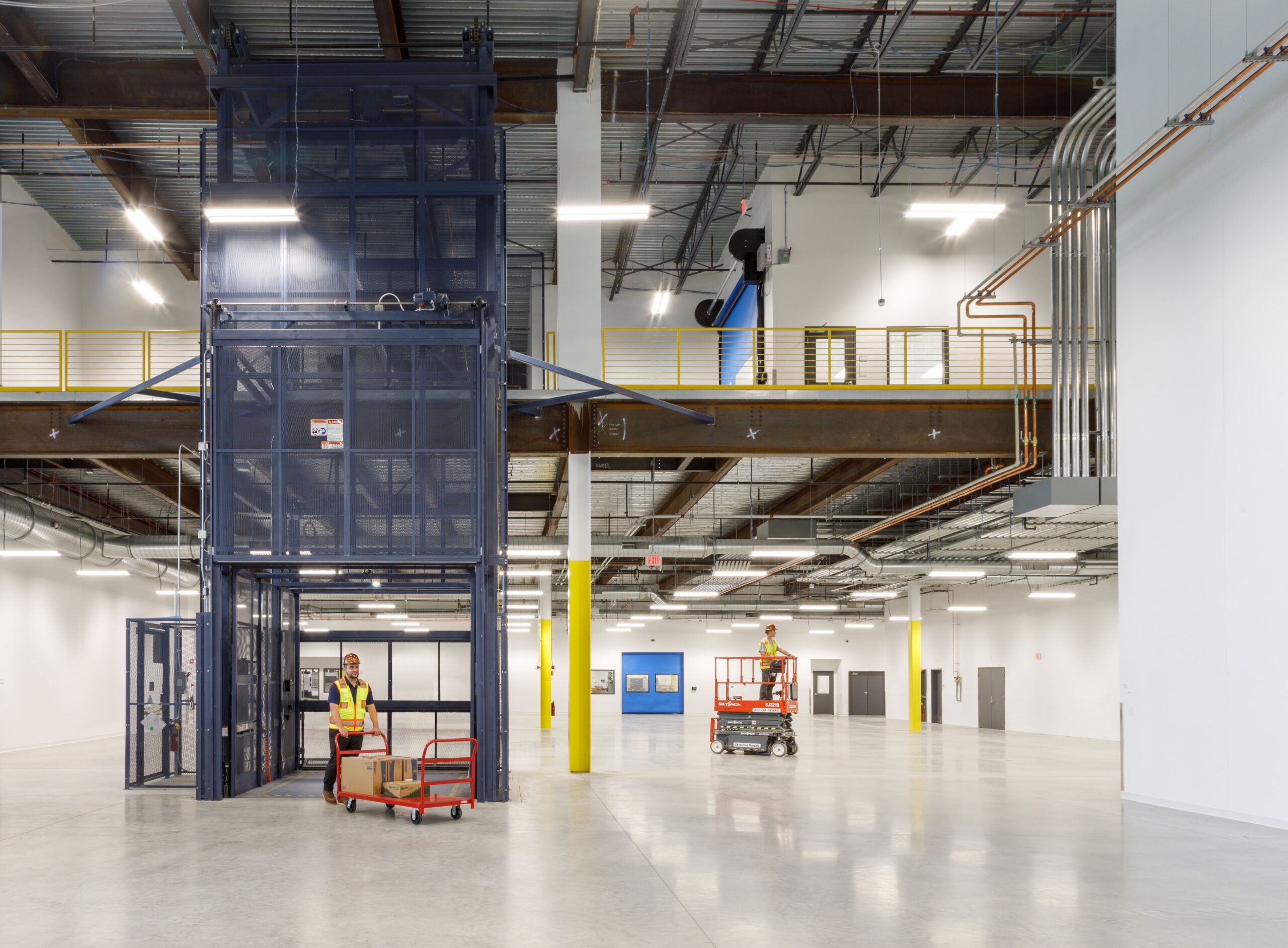
Excerpt from Mark Fallon at Banker & Tradesman
Developers Lure Climatech and Advanced Manufacturing
The traditional flex/R&D inventory that is mostly well-known throughout the commonwealth is
frequently defined as vintage, pre-2000-era product. It predominately consists of 2-story brick
buildings, with 1,800 to 3,000 amps of power available.
This dynamic has fundamentally changed with the advent of a relatively nascent industry to
Massachusetts: climatetech, energy tech, advanced manufacturing and robotics.
This rapidly growing industry has been further reinforced by the Mass Leads Act’s $1 billion
investment, as well as a massive inflow of federal dollars. The CHIPS Act directs $280 billion in total
spending, roughly $52 billion of which is earmarked for semiconductor manufacturing and R&D.
As a consequence, the Department of Defense selected Massachusetts as one of the eight existing
microelectronics hubs in the country.
Private Equity Joining Government Funding
Furthermore, private equity and venture capital investment inflow continues to provide vital financial
backing.
Per the Massachusetts Clean Energy Center, Massachusetts is the second-largest climate tech
ecosystem in the country and ranks first in climate tech startups per capita. These users have now
taken center stage as the new, predominant tenants in the market, and they require specialized
assets to conduct their business well beyond what current inventory can provide.
These bespoke buildings command a significant rent premium, which attracts the interest of investors
and developers alike.
Per Hunneman Research, rents for these new buildings are the highest of any industrial/flex product
and come with outsized tenant improvement packages. Historically, tenants who have required this
type of space have been forced to retrofit older, dated stock that is not a true representation of the
space they need.
These new builds share several key characteristics: they usually have an RBA of under 200,000
square feet, adaptable layouts, dramatically enhanced electrical capacity (usually exceeding 6,000
amps at a minimum, and often rising to over 8,000 amps), and integration of laboratory, engineering
and manufacturing functions.
Clear heights are important as well: Traditional flex inventory frequently runs lower than 20 feet,
whereas this new generation of product runs at a minimum of 25 feet and can exceed 34 feet.
This is a critical component: while retrofitting is possible, it is extremely capital- and time-intensive to
change this aspect of the physical infrastructure. These heights allow users to stack mechanical
processes above the floor, creating room to install tall equipment (think: cranes, tanks and gantries),
and make adjustments later.
A final necessity is column spacing. New buildings for this archetype command wide open spacing –
40-by-40, 40-by-60 –which allows for reconfigurable floors for equipment, process lines, and
mezzanines.
Metro North Projects Test Market
As evidence of the popularity of this burgeoning asset class, the proof is in the leasing and the
construction.
King Street Properties has capitalized on this trend: Pathway Devens has completed four buildings of its master campus and has met with significant success. Electric Hydrogen, a company that manufactures electrolyzer systems, committed to the entire 187,000-square-foot building at 33 Jackson Road, and Vulcan Forms, a digital manufacturing company that utilizes laser printing systems, leases the entire facility at 39 Jackson Road.
Read the full article on Banker & Tradesman